

Punctum/Metaphor by Carolina Ebeid
Punctum/Metaphor
Carolina EbeidLove remains a kind of present tense. This is how we describe the scenes in photographs—as though the actions in them were still happening. My father is throwing a rock in this picture. My father keeps lions in his chest & they rip apart a gazelle in this picture.
A man throwing a rock; the image holds an old grammar. This rock has yet to leave the hand, to measure the horizontal span from A to B. Nor has it completed the vertical distance from first line to last line, riding a tangle of syntax. The photograph captures a skirmish in the West Bank town of Nablus; the man hurling the rock is my father insofar as Juliet is the sun.
SELECTED BY ALINA STEFANESCU
I am haunted by a photograph of the young Roland Barthes in the arms of his beloved mother which Barthes captioned: “The demand for love.” Haunted, too, by the tenderness in the fingertips of Carolina Ebeid’s verbs as they reach behind the eyes of her father’s photograph, gravitating between the symbol and the person.
Recognition depends on the way light and distance shape the subject. This resembles the camera, itself, which makes use of an opening called an “aperture” in order to produce an image. Light passes through this given gap, this variable aperture, and preserves the instant.
Western media would label the Palestinian man throwing a rock in the West Bank a “terrorist”. These distinctions are absorbed, accepted as given, and written into the present as a presence through photographs and interpretations. In the grammar of possibility, the “rock has yet to leave the hand.” The story of what happened is revisited in the photo of what is happening. The “old grammar” held by the image could be the legend of David hurling a rock at Goliath or the Wanted poster naming the enemy. We speak and live in multiple tenses. We conjugate those tenses into ways of being in time. We describe the scenes “as though the actions in them were still happening.” Ebeid’s poem reopens the image and leaves it opening.
ABOUT ALINA STEFANESCU
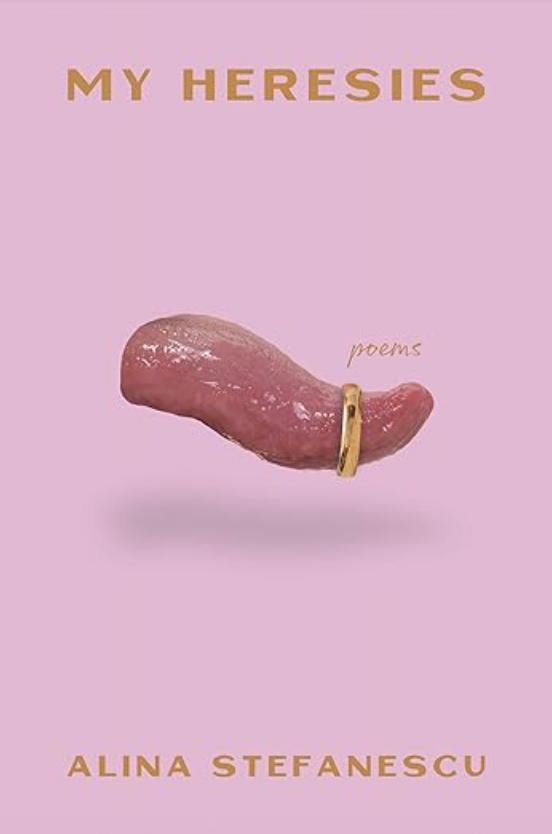
Alina Stefanescu was born in Romania and lives in Birmingham, Alabama with her partner and several intense mammals. Recent books include a creative nonfiction chapbook, Ribald (Bull City Press Inch Series), and Dor, which won the Wandering Aengus Press Prize. Her debut fiction collection, Every Mask I Tried On, won the Brighthorse Books Prize. Alina’s poems, essays, and fiction can be found in Prairie Schooner, North American Review, World Literature Today, Pleiades, Poetry, BOMB, Crab Creek Review, and others. Her new poetry collection, My Heresies, was published by Sarabande Books in late April 2025.
KEEP READING
SHARED WITH GRATITUDE
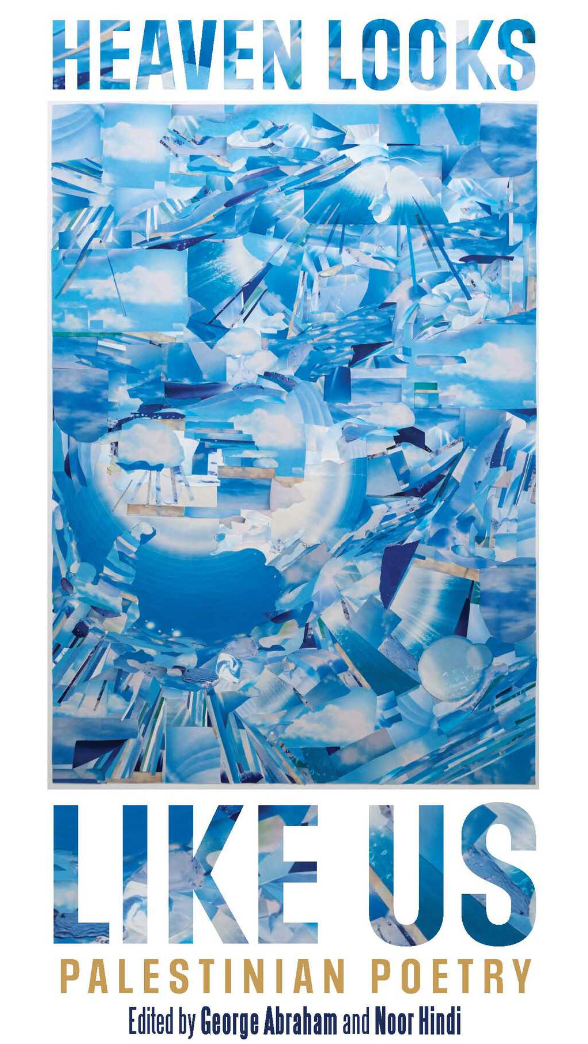
This poem appeared in Heaven Looks Like Us edited by George Abraham, and Noor Hindi, published by Haymarket Books, 2025. (Available on: Amazon • Bookshop)
DESCRIPTION
“An anthology of contemporary poetry connecting Palestinians across generations, languages, and borders.
Poetry has always served as a mode of resistance in Palestinian culture. In defiance of dispossession and decades of military siege, of a nakba that never ended, of historical and cultural obfuscation, of unrelenting violence and thousands of martyred people, the “power to narrate,” as Edward Said wrote, remains a necessary tool for self-determination. The poems collected here reclaim that power, bridging borders, languages, and generations to forge new conversations around resistance and liberation.
As Palestinian history remains haunted by exile, violence, and grief, so, too, are the poems in this anthology. And yet, editors George Abraham and Noor Hindi present these realities alongside other themes that are also true: queer and feminist perspectives, eco-poetry, meditations on love and time, and lineages of protest. This anthology dares to imagine a future beyond a nation-state for Palestinian people everywhere. Contributors include Refaat Alareer, Mahmoud Darwish, Naomi Shihab Nye, Mohammed El-Kurd, A.D. Lauren-Abunassar, Tarik Dobbs, and many other voices, both established and ascending.
Heaven Looks Like Us is a battle-cry against the annihilation of a people. It’s also a love letter to Palestinian ancestors, their descendants, and their land, to all anti-colonial and anti-imperialist struggles, to a history that will never be forgotten, and to a future in which there thrives a free, free Palestine.” (Source)
ABOUT CAROLINA EBEID
Carolina Ebeid is a Cuban and Palestinian American poet and the author of You Ask Me to Talk About the Interior (Noemi Press, 2016), selected as one of the ten best debuts of 2016 by Poets & Writers. Ebeid’s work has been supported by Bread Loaf, CantoMundo, a Lannan Foundation residency, and a National Endowment for the Arts fellowship. A visiting assistant professor at Brown University and a poetry editor for The Rumpus and Visible Binary, Ebeid lives in Providence. (Source)
Read more poems by Carolina Ebeid • Find books by this poet on Amazon • Bookshop • Follow on Instagram • Twitter • Website • Or view my library
ENDNOTES
- This is Day 43 of Poems We Carry, celebrating the 20th anniversary of Read A Little Poetry—a living archive I’ve nurtured for two decades. For this milestone series, I invited writers I deeply admire to share poems that have meant something to them over time.
- Explore other works in pursuit of: memory • love • image • Or browse the index
- If this work resonates with you, please consider supporting the archive. Thank you for reading.


